



So they say they have an integration

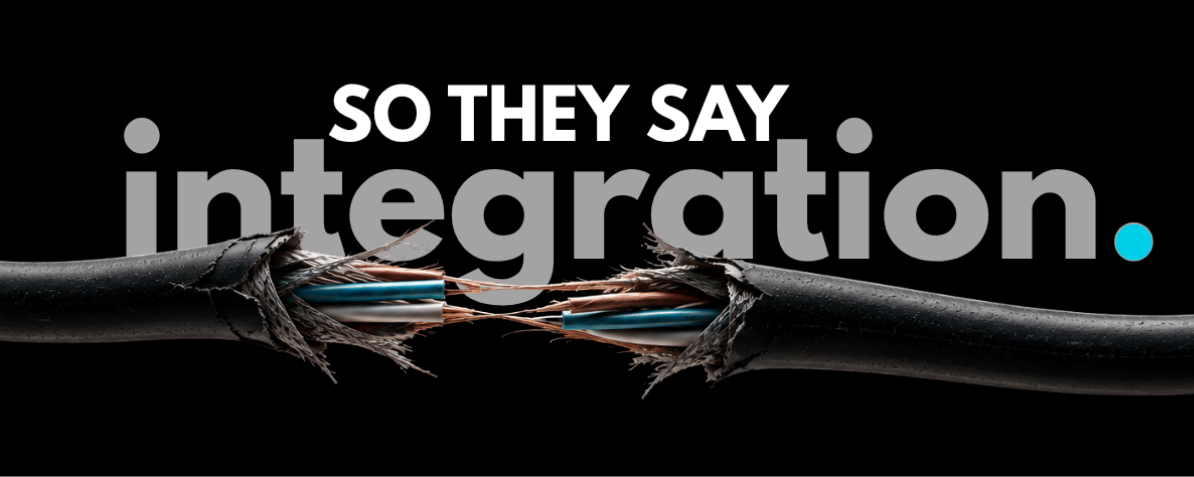
So they say they have an integration? You're selecting a partner, a system and with that a list of requirements go out and the question is “do you integrate with a-z?” — often times it gets turned around as a checked box or maybe it has about as much color as ‘we comply’ or ‘yes’. I have spent my entire career on the wrong end of that answer. Beholden to someone else's roadmap, limited to the options a partner says they have, and then limited again by what those integrations actually do once we finally get them.
The problem.
Campuses are complex environments — this created what could be called “short-term integrations” or just straight up bespoke integrations, integrations were seen as a means to an end. Something required in the moment to get their massive platform in the door but not something that was maintained. And when it broke, and it always broke, the fix came back as a professional services quote. You paid to build it. Then you paid again when it stopped working, for reasons that had nothing to do with you.
The truth behind many integrations is they were meant to serve the purpose of the project they were implemented for — bespoke — and much like the systems that house these integrations they have just become another line of technical debt, or a ticket that someone needs to work on but never gets picked up.
This is the problem. Integrations should not be a deliverable of a project, they should be a foundational element that is secure regardless of the partner. A platform that houses the communication and ensures that regardless of decisions across your campus you have flexibility to make changes through a toggle, NOT a bill in your inbox.
And this is where the checked box really falls apart. A credential integration is not a number that ties an ID back to a person. That is the easy part. Every system in the chain has to understand a set of lifecycle rules and react to each one in a specific way. A card gets reported lost and the old number has to die everywhere at once while the new one comes alive. A student graduates but keeps library access through the summer. Someone moves from student to staff and the same person now needs a different set of doors. A credential is suspended on Tuesday and reinstated on Thursday. An employee is terminated on a Friday afternoon. Every one of those events means something different to the door, to the point of sale, to the meal plan, and to the print release station, and getting any of them wrong in either direction is either a security problem or a very angry phone call. That is what an integration actually has to do. “Yes, we integrate” tells you nothing about whether any of it was built.
You are the one in the middle of that email thread, and you are the only person on it who cannot walk away.
Today you see companies saying “look how many integrations we have” and they will flash some huge number that almost seems impossible to maintain. And the truth here is that some companies have grown large enough to say “well they integrate with us and we aren't responsible for the way their integration works.” Two competing products can both say they have an integration and mean two completely different things. Then something breaks and both vendors point at each other. You are the one in the middle of that email thread, and you are the only person on it who cannot walk away.
It lands on the card office. It is the student at the counter on move in day who cannot get into their residence hall. It is the ticket that comes back closed as working as designed. It is the meeting where you find out dining already picked a new system and nobody thought to ask what that does to your credentials.
Our origin.
FutureState entered the market following a collective of decades in higher ed between my co-founder and I, where we lived this exact reality every single day. Fragile integrations, very unclear capabilities, rate limits that created widespread delays and all of this came together to create a less than ideal experience for students, staff and faculty on the campuses we served.
Joe (my co-founder and now CEO of FutureState) has a story about when he started at our previous institution on Monday at the end of a semester, he went and got his photo taken and his university credential printed and tapped it at the door (actually, I think he swiped it, but that's a whole other story) and it flashed red. Then he tried again that afternoon, still red. The next day, still red. You get the point. It took until Thursday, 4 days after that card had been produced for it to actually work its way through the system(s) to activate at the door that let him into his office.
Four days. Maybe something got held up. Maybe it was just some process that hadn't processed. Maybe HR forgot to trigger the record to be fully active. The reason doesn't matter. What mattered was that the system failed, and to unfamiliar eyes it looked like a card office issue.
I can't tell you how many stories like this I have experienced, how many move-in weekends I have sat in the card office and watched a card provisioned or printed just to be back in the office later that day because “their card doesn't work” and then for that student to be sent around campus where the card office says ‘you need to talk to x department’ just for them to show up an hour later and say ‘they told me to talk to you’. No one really knew what was wrong but there was a student in front of them who had an issue and no one knew where the breakdown was happening.
So when we had the opportunity to rethink and then redo our entire integration landscape around our credentials we had very pointed conversations not just about the integrations that vendors provided but also the depth of those integrations and everything seemed to come up short. Eventually we were left with really only one option, and not one that we took lightly, build it ourselves (and by ourselves I don't mean us, I mean our crack team of developers that would be assigned to this massive project).
Now if you have ever been in the position where the question is ‘build it yourself’ or ‘buy it’ you know it's usually intense back and forth of trying to determine what is the cost, not just now but long term, we have to maintain this, and we need to support it and most of the time in our case we always leaned towards buy it. But in this case there wasn't another option, there was nothing to buy because what we knew we wanted didn't exist.
As I sit here and write this I feel that it is important to call out that building out this platform, the technology that eventually became CardSync, a platform that was everything we had always wanted, took a tremendous effort. Tens of thousands of hours from a dedicated team and errors came up over and over again but we eventually got to a place where it replaced what we once had and along with it came so many benefits. Access the moment credentials were printed, deactivations that occurred the moment someone left or graduated, and for the first time we could see what was happening between the systems instead of guessing which one had dropped the ball. The end result was not just a better experience but a more automated and more secure campus.
FutureState.
FutureState began as a project where we knew that we could do integrations better. Where we could set a foundation independent of the broader system choices and that mission is what continues to inform our products today. When we left the university and chose to start FutureState on the back of the technology we created it was pretty obvious on day one that this wasn't a system that could be lifted up and transplanted anywhere. In many ways what was built was bespoke to the institution where it was created. So we fundamentally rebuilt it from the ground up. If CardSync was going to move beyond working for one institution to being a foundational element that truly enabled choice across any campus then the entire marketplace of integrations needed to be ours and there needed to be standards and it needed to be self-service and it absolutely could not be a nickel and dime model with a price tag on every integration.
Integrations are not a feature of the product. The integrations are the product.
So we did just that, we reengineered it, we began the process of talking with anybody and everybody who would listen about letting us integrate to them, telling our story about how lackluster the “integrations” we have been sold for the last decade are, how we believe that we can provide a better option to fix challenges that they have all heard. And that's where we have been for the last 14 or so months. Living in the integrations that make up a campus. This is truly our focus at FutureState. Integrations are not a feature of the product, the integrations are the product, and every single one has standards that must be met and information that must be surfaced, because you cannot support what you cannot see.
Doing only this means we see things nobody else bothers to look at. A sync that is getting slower. A partner API that started returning something different last Tuesday. We can tell you an integration is failing before it becomes a ticket, and before a student is standing at your desk asking why their card does not work. Most of what we build is not flashy. It is the stuff you only appreciate if you have ever been the person who had to explain the issue or outage.
FutureState exists specifically to decouple the integrations tying you to a credential system. To truly provide choice at every layer, including one that for the better part of the last decade hasn't been a choice, mobile credentials.
Mobile credential integrations.
To really understand what that means there are two key terms that often get used interchangeably but are truly different and need to be understood.
The way every single mobile wallet launch had gone for the last eight or so years is one of two ways.
- Your credential manager is your meal plan provider and they work with credential providers like HID or Allegion to add credentials to the wallet.
- Your meal plan provider is your credential manager AND credential provider.
Those were your options and the key constant in both of those scenarios is who is your meal plan provider.
To really paint this picture of what this looks like there is an interesting statistic. There are some 200ish schools in the US that have launched Student ID in wallet and at the time of writing this not one school that has launched mobile has switched their meal plan system OR their credential manager since. Considering we are over 8 years removed since those original schools launched in 2018 it really paints a picture of how something that is so incredible for those campuses fundamentally locked them into a specific provider.
That was until last year. When the University of Arizona launched Student ID in Apple Wallet and Google Wallet in August of 2025, it was the first time Student ID was launched in higher education without the meal plan provider. What was once the only option is still an option. It is just no longer the default, and it is no longer the only choice.
CardSync integrated directly with the credential manager to communicate the credential events across the entire enterprise and the credential manager was just a spoke on a hub it didn't own. That was our goal. Student ID in Apple Wallet and Google Wallet without locking us into any one monolithic system.
When we started FutureState we made a conscious decision to not be a credential manager. This was very intentional, because the moment we own the credential management service we have a reason to keep you on ours, and then we are just the next version of the thing I have spent this whole article calling out. We wanted to be the foundation that enables your decisions, not the thing that forces one.
Bundling credentials, particularly mobile, was never the right answer. It was just the only option.
At our core we believe in creating options. A new choice. Not one that is bundled with your meal plan system but something that can be chosen in isolation. One that prevents the scenario where the meal plan and dining offices decide they want to switch their meal plan system and that creates a snowball that forces the credentials in wallet to change too. Bundling credentials, particularly mobile, was never the right answer, it was just the only option.
So fast forward to today, what does this actually mean for a university? Well, it sort of depends on where you are.
If you already launched mobile
If you are a campus who already launched mobile credentials and you feel stuck with your credential manager, this is a path to decouple and put yourself in a position where you aren't locked into any one credential manager's web.
I won't sit here and say that this isn't without its own challenges because if you have done this project you know what a monumental task it is, but the other side of this project is truly unfettered choice. This switch also comes with the other benefits of being on the latest platform, which has its own set of benefits and new options.
Talk to us about decouplingIf you have not launched yet
And if you're a campus who wants a roadmap to wallet credentials and are unsure how to get there, or if you are a card office, or physical access, or IT team with an entirely separate reporting line than the meal plan office and find yourself in conversations where everyone agrees they want wallet credentials but you are reluctant to adopt the meal plan office's system to manage those credentials, this is the path forward.
Get a roadmap to walletOur platform was specifically designed to be the first step to make mobile possible. Every integration we build, manage and maintain supports all modalities of credentials, physical, mobile, biometrics and all the variations in those categories by default.
Closing.
They say they have an integration.
- Ask what it actually does.
- Ask what breaks and who pays for it when it does.
- Leaving is always possible. Ask what it costs.
- Ask if the hardware can come with you, or if it is a paperweight without them.
- Ask if they are an all-in-one, or the best in the world at one part of a bigger picture.
We built this because we got tired of the answers. You should not have to pick a meal plan system to get a credential into a wallet. You should not have to replace a platform to fix one integration. And you should not find out what an integration can really do six months after you signed for it.
Stop asking who your credential and meal plan system is. Start asking who is best at each, and what holds it all together.
Are they an all-in-one, or the best in the world at one part of a bigger picture?